
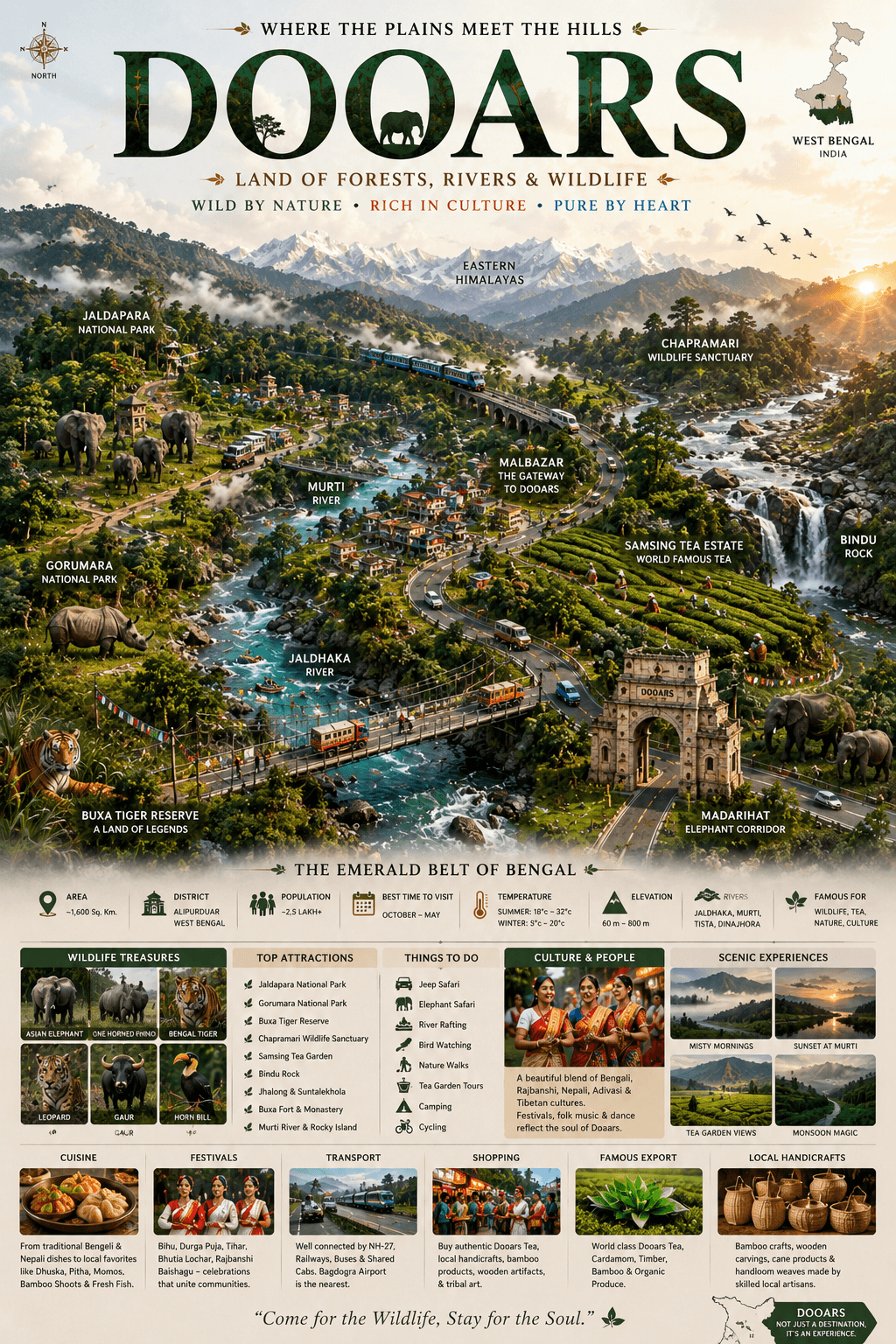
Planning a Dooars Tour — A Short Guide
The Dooars (literally 'doors' — the gateways into Bhutan and the eastern Himalayas) is a 130-km lowland belt that runs through the northern districts of Jalpaiguri, Alipurduar and Cooch Behar in West Bengal, plus a small slice of western Assam. The region spans roughly 8,000 km² of alluvial floodplain, sub-tropical broadleaf forest, sal woodlands and tea estate — broken by the Teesta, Torsa, Raidak and Sankosh rivers tumbling out of Bhutan.
Four major protected areas form the backbone of any Dooars tour: Gorumara National Park (one-horned rhino, Indian bison, elephant herds), Jaldapara National Park (highest rhino density outside Kaziranga), Buxa Tiger Reserve (tiger, leopard, clouded leopard) and Chapramari Wildlife Sanctuary (gaur, elephant corridor). The Mahananda Wildlife Sanctuary closer to Siliguri completes the picture.
Best time to visit the Dooars
Mid-October to end-April is the only window — parks close for monsoon between June 15 and September 15 each year (Bengal Forest Department regulation). October–November brings clear skies and post-monsoon green; December–February is the prime tiger and leopard sighting window at Buxa; March–April offers the highest mammal density at Gorumara and Jaldapara as undergrowth thins out. Birding peaks in December–January when migrants arrive at Rasik Bil and the Jayanti riverbed.
How to reach the Dooars
The nearest airport is Bagdogra (IXB) — 70 km to Gorumara, 160 km to Jaldapara, 220 km to Buxa. The nearest railheads are New Jalpaiguri (NJP), New Mal Junction (for Lataguri / Gorumara), Hasimara (for Jaldapara) and Alipurduar Junction (for Buxa). All our packages include private SUVs and English-speaking naturalist guides; gypsy safaris and elephant rides are pre-booked under Forest Department quotas (limited daily slots — book 30 days ahead).
What to eat in the Dooars
Local Rajbongshi cuisine — shidol shutki (fermented fish chutney), mishti pulao with country chicken, kochur loti curry, narkel naru, and patishapta for dessert. The tea estates serve traditional planter's breakfasts (eggs, sausage, fried tomato, estate-direct tea), and the forest lodges have begun adding tribal-cuisine evenings — Rabha haria (rice beer) tasting, Mech bamboo-shoot dishes, Toto millet rotis.